
Clayton, NC & greater Raleigh
Retaining Walls in Clayton, NC
A retaining wall is holding tons of wet clay in place. Everything that makes one last is behind the face, where you will never see it.
What it involves
Retaining Walls, done properly
Most of the retaining wall failures you see around the Triangle come down to the same two things: no drainage behind the wall, and no reinforcement into the slope. Saturated clay is heavy, and it pushes. A wall built without a way to relieve that water will lean, then bulge, then come apart at a joint.
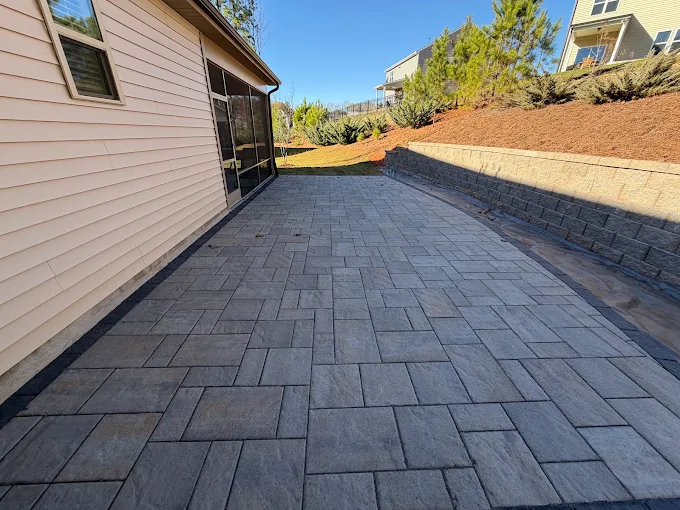
We build segmental block walls with a compacted leveling pad, a drainage stone zone behind the block, filter fabric to keep the soil out of that stone, an outlet for the water to actually leave, and geogrid reinforcement tied back into the slope where the height and load call for it.
The payoff is usable ground. A slope that was too steep to mow becomes a level lawn, a patio gets a flat pad to sit on, or a driveway edge stops washing out every spring. Walls over a certain height, or carrying a load above them, need engineering and permitting — we will tell you if yours is in that category during the estimate rather than after the block is on site.
Drainage behind the block
Clean stone, filter fabric and a real outlet, so water leaves the back of the wall instead of loading it.
Reinforced into the slope
Geogrid tied back into compacted fill where the height and surcharge call for it, so the wall and the hill act as one mass.
A compacted leveling pad
The base course is set on compacted aggregate and leveled precisely — every course above it inherits whatever happens here.
Straight talk about engineering
If your wall needs a stamped design or a permit because of its height or what sits above it, you will hear that at the estimate.
Our work
Retaining Walls we have built
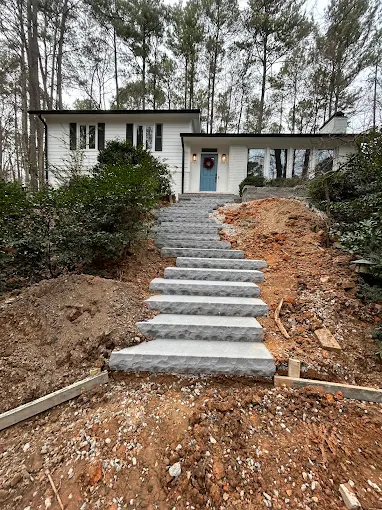
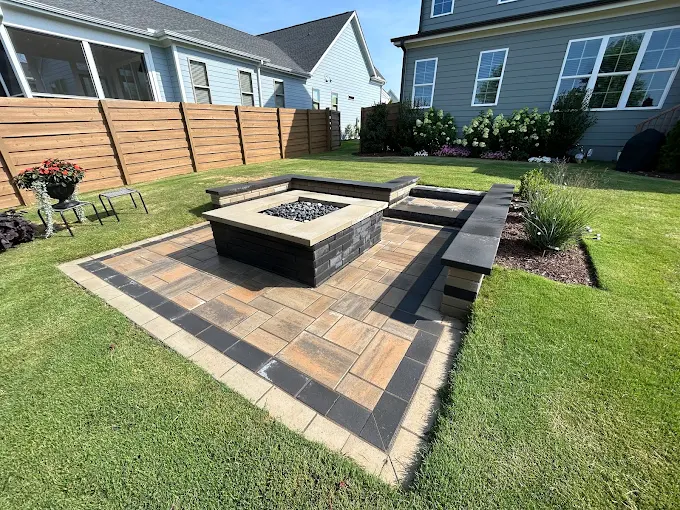
Photographs of this crew’s own projects. Captions describe only what is in the picture.
Questions
Retaining Walls: the questions we get asked
How tall can a retaining wall be before it needs engineering?
There is a height above which jurisdictions require a design stamped by an engineer, and it drops further if there is a surcharge above the wall — a driveway, a pool, a structure or a second wall stepped above it. The exact threshold depends on your municipality. We check it for your address and your wall, and we will tell you the answer before you commit to anything.
Why do retaining walls fail?
Almost always water and reinforcement. Without a drainage zone and an outlet behind the wall, saturated soil puts a load on the block that it was never meant to carry, and without geogrid tied into the slope a taller wall has nothing resisting that push but its own weight. Both are behind the wall, both are invisible when the job is done, and both are where the cost of doing it properly sits.
Can you fix a wall that is already leaning?
Sometimes, but be skeptical of anyone who promises it sight unseen. A wall that is leaning is usually telling you that the drainage or the reinforcement behind it was never right, and cosmetic repairs to the face do not address that. We will come and look, tell you honestly whether it is a repair or a rebuild, and explain what we are seeing.
Can a retaining wall be terraced instead of built tall?
Often, and it is frequently the better answer. Two shorter walls stepped back from each other can hold the same grade, look lighter, and give you a planting terrace between them. The spacing between terraces matters structurally though — set too close together, the upper wall becomes a surcharge on the lower one and you are back to needing engineering.
Retaining Walls across the greater Raleigh area
We build retaining walls in Clayton, Raleigh, Garner, Wendell, Knightdale, Zebulon, Wake Forest, Smithfield, Cary, Apex, Holly Springs, Fuquay-Varina, Angier, Chapel Hill and Wilson, NC. See what we do in each town.
Often built together
Other services
Next step
Thinking about retaining walls?
Tell us roughly what you have in mind and where you are. We will come out, look at the grade and the access, and give you a straight answer about what it takes.