
Clayton, NC & greater Raleigh
Drainage in Clayton, NC
Central North Carolina clay does not absorb much. Drainage is what stops water from sitting against your foundation, drowning your lawn and undermining everything else we build.
What it involves
Drainage, done properly
Water problems are the most common thing we get called about, and they are rarely mysterious. Somewhere, water arrives faster than the ground can take it — off a roof, down a slope, off a neighboring lot or off a hard surface — and there is nowhere for it to go. The fix is to give it a route.
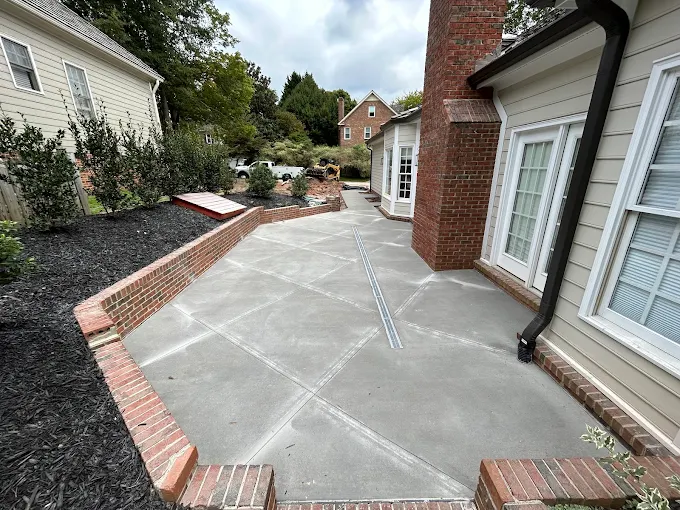
Depending on what we find, that route might be a trench drain cast into a patio or driveway, a catch basin at the low point, a French drain intercepting water moving through the soil, solid pipe carrying downspouts away from the foundation, or simply regrading so the surface falls the right way. Most jobs use more than one of those.
Drainage is also part of every hardscape we build, whether you asked for it or not: patios are pitched to shed water, retaining walls get a drainage zone and an outlet, and slabs get a fall away from the house. Fixing a water problem is much cheaper before the patio goes down than after.
Trench and channel drains
Cast flush into concrete or set at the edge of paving, to catch sheet water before it reaches the house.
Catch basins and piping
Basins at the low points, tied into solid pipe running to a sensible outlet rather than into a hole in the ground.
Downspout extensions
Roof water piped well away from the foundation instead of discharging into the same corner of the flowerbed every storm.
Regrading
Sometimes the answer is not a pipe at all — it is cutting the ground so it falls the way it should have in the first place.
Our work
Drainage we have built
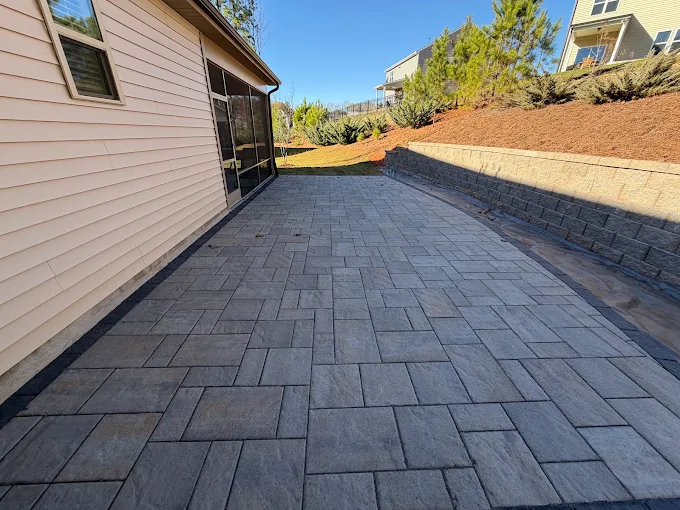
Photographs of this crew’s own projects. Captions describe only what is in the picture.
Questions
Drainage: the questions we get asked
Why does water sit in my yard for days after it rains?
Usually a combination of heavy clay subsoil, compaction from construction, and a low spot with no outlet. Clay holds water rather than letting it percolate, so once a depression fills, it can only leave by evaporation. The fix is to give the low point a route out — a basin and pipe, a French drain, or regrading so the water never collects there.
What is a French drain, and do I need one?
A French drain is a gravel-filled trench with a perforated pipe in it, wrapped in filter fabric, that intercepts water moving through the soil and carries it away. It is the right tool for subsurface water — a soggy area partway down a slope, or water tracking toward a foundation. It is not the right tool for water sheeting off a hard surface; that wants a channel drain or a catch basin.
Where does the water actually go?
That is the question that decides whether a drainage system works, and it is the first thing we look at. Water has to daylight somewhere lower than where it was collected — a swale, a bed, a street or a lower part of the property. If there is no gravity outlet available, the design changes, and we will tell you that up front instead of piping water into a dead end.
Can drainage be added under an existing patio?
It depends on the surface. Pavers can be lifted and reset, so running a drain under an existing paver patio is realistic. Poured concrete has to be cut and patched, which is visible. That is the practical reason we plan drainage into a build from the start rather than treating it as an add-on.
Drainage across the greater Raleigh area
We build drainage in Clayton, Raleigh, Garner, Wendell, Knightdale, Zebulon, Wake Forest, Smithfield, Cary, Apex, Holly Springs, Fuquay-Varina, Angier, Chapel Hill and Wilson, NC. See what we do in each town.
Often built together
Other services
Next step
Thinking about drainage?
Tell us roughly what you have in mind and where you are. We will come out, look at the grade and the access, and give you a straight answer about what it takes.